
Discover Navarra’s historic cities as a layered palimpsest where Roman footprints, medieval fortifications, and vibrant market life reveal how walls, bridges, and plazas once governed movement, memory, and meaning. You’ll trace urban boundaries shaped by gates and ramparts, see how restoration preserves material traces while allowing modern life to continue, and feel civic rituals echo through palaces, churches, and processions. Along the Camino, routes weave memory with trade and legend, hinting at broader regional connections still to come. Keep exploring ahead.
Key Takeaways
- Navarra’s historic cities weave medieval fortifications, gates, and palaces with modern architecture, reflecting continuity and civic identity across centuries.
- Pilgrimage routes like the Camino de Santiago imprint memory through markers, signage, and urban narratives shaping regional identity.
- Strategic crossings, bridges, and walls reveal how transport and defense shaped urban planning and economic exchange.
- Market life, crafts, and river valleys illustrate how trade, culture, and daily rituals sustain social memory in cities like Pamplona and Tudela.
- A well-planned two-to-four-day loop—from Pamplona to Olite, Estella, and Tudela—offers layered insights into each city’s historical memory.
Navarra’s Historic Cities: An Overview
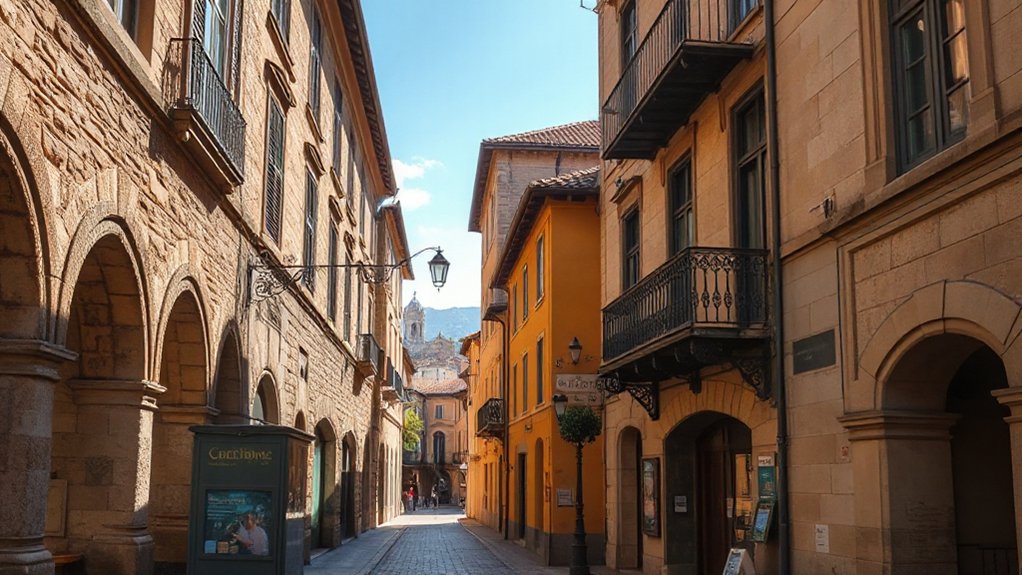
Navarra’s historic cities crystallize a medieval-to-modern arc where walls, streets, and squares encode centuries of rule, trade, and culture. You trace how fortifications, basilicas, and markets map political shifts from medieval lordships to mercantile networks, then to modern administration.
This overview anchors you in common threads: urban grids that preserve ritual paths, archives embedded in stone, and ongoing adaptation to changing economies. You’ll notice how civic spaces host memory—palabras of craftsmen, guilds, and chroniclers—while archives record daily life, weathering fires and reforms.
Local cuisine surfaces as documentary evidence of exchange, migration, and boundary crafting, while traditional festivals reveal seasonal rhythms and communal identity. Through these layers, you develop a concise picture of Navarra’s city morphology, function, and cultural continuity.
Why Navarra’s Urban Heritage Matters
Urban heritage matters because it anchors identity amid change, linking past decisions to present-day life. You analyze how streets, plazas, and stonework carry collective memory, shaping how locals interpret new policies and projects.
The archival record shows repeated patterns: citizens negotiating space, authorities balancing preservation with development, merchants adapting to evolving trade routes. Urban renewal cycles reveal how priority shifts—from defense and worship to mobility and tourism—reframe neighborhoods without erasing their core character.
You note how incremental restorations preserve material traces while enabling functional upgrades, ensuring livability without erasure. Modern architecture, when thoughtfully integrated, becomes a dialogue rather than a distraction, reflecting continuity and risk.
In Navarra, this synthesis sustains cultural resilience, guiding sustainable growth while honoring inherited urban form.
Pamplona: From Roman Roots to Modern Celebrations
You’ll trace Pamplona’s Roman roots as you map how early walls and forums shape today’s daily rituals. The Fiesta Timelines reveal how celebrations evolve, linking ancient processions to modern streets filled with color and courage.
As you review Walled City Journeys, you’ll see how terrain, memory, and architecture frame a continuous pulse from empire’s edge to contemporary ceremony.
Roman Roots Reflected
Nestled beneath Pamplona’s modern streets lies a legacy etched in stone and memory, where Roman foundations still pulse through the city’s present-day rhythm. You trace the layers as archives reveal, not myths, how Roman influence shaped street layouts, aqueduct remnants, and civic spaces that anchored later medieval life.
The material record speaks in quiet, precise terms: inscribed stones, column bases, and fragments that survive in museums and courtyards, offering a measured timeline rather than conjecture. You observe how urban reuse demonstrates continuity, transforming public spaces without erasing the past.
Through these artifacts, you read a city that learned governance, defense, and commerce from a distant empire, while keeping its own identities intact.
The Fiesta Timelines
From the measured aftershocks of Roman foundations, Pamplona’s fiestas unfold as a palimpsest of ritual and memory. You trace how early populares gatherings evolved into structured celebrations, each layer underscored by selective memory and urban space.
In archival whispers, you discover how processions, choral hymns, and market feasts codified civic identity, turning streets into stages for communal affirmation. The timelines reveal punctuated shifts: medieval ferias, Baroque refinements, and 20th‑century adaptations that absorbed modern mass culture without erasing tradition.
You observe the symbiosis between festivity and everyday life, where local cuisine punctuates rites and traditional festivals anchor seasonal cadence. This analytic thread clarifies continuity amid change, showing Pamplona’s celebrations as a living record of place, memory, and resilience.
Walled City Journeys
How did a walled perimeter shape Pamplona’s journeys through time, guiding movement from Roman outpost to modern celebratory city? You trace gates, ramparts, and lanes that mapped power, trade, and ritual. The walls framed routes that evolved from defensive corridors to pedestrian arteries, preserving memory while inviting new use.
Archival fragments reveal a city negotiating conquest, renewal, and festival spectacle, with each breach or repair altering movement and meaning. In modern times, contemporary architecture threads through the old fabric, while a surge of Modern art references generate dialogue between history and innovation.
You observe how perimeter discipline gave rise to a dynamic, yet cohesive, urban story of continuity and reinvention.
- Strategic gatehouses as memory nodes
- Pathways narrowing into plazas for public life
- Murals and sculptures syncing history with Modern art
- Restoration guiding adaptive reuse of walls and routes
Olite: The Castle of Royal Fortifications

Olite reveals its Royal Fortifications as a living archive, where the stonework and battlements tell how medieval power organized space and ceremony.
You’ll compare the castle’s thick walls, towers, and gatehouses to the political logic of its era, tracing how architecture framed royal authority.
This snapshot primes the discussion of Royal Fortifications Spotlight and Medieval Architecture Highlights by linking function to form in a single, coherent narrative.
Royal Fortifications Spotlight
Olite’s Castle of Royal Fortifications rises as a masterclass in medieval defense, where towering crenellations and a drum of concentric walls reveal a deliberate escalation of military architecture. You observe how the layout encodes function, with gates, towers, and keeps aligned to control approaches, supply routes, and sightlines.
The stones themselves tell records of campaigns, sieges, and royal budgets, yet also reveal adaptive reuse through centuries. You feel how royal fortifications shaped governance, turning residence into strategic liability and prestige into deterrence. This is archival impulse: to map terrain, assess engineering, and trace decisions that extended a border of power.
The site compels you to read both plan and policy, linking space to sovereignty.
- Structural hierarchy defines access and defense
- Concentric design concentrates force at chokepoints
- Medieval bastions anchor margin and morale
- Stonework records shifting technologies and threats
Medieval Architecture Highlights
From the moment you step onto Olite’s Castle of Royal Fortifications, the architecture speaks in layered dialogue: ashlar masonry, crenellated battlements, and a drum of concentric walls that map a deliberate escalation of defense. You observe a carefully choreographed sequence that blends fortress pragmatism with courtly expression.
The layout guides movement through galleries and halls as if composing a narrative of sovereignty, with decisive attention to sightlines and protection. Medieval festivals once animated these stone corridors, where light and shadow mapped ritual timing across feasting and testimony.
Rich plasterwork and carved vaults reveal progression styles, while ancient murals survive as fragments of dynastic memory. Each chamber records adaptive reuse, revealing how architecture preserved authority, culture, and continuity within Navarra’s royal frontier.
Puente La Reina: the Pilgrim’s Gateway
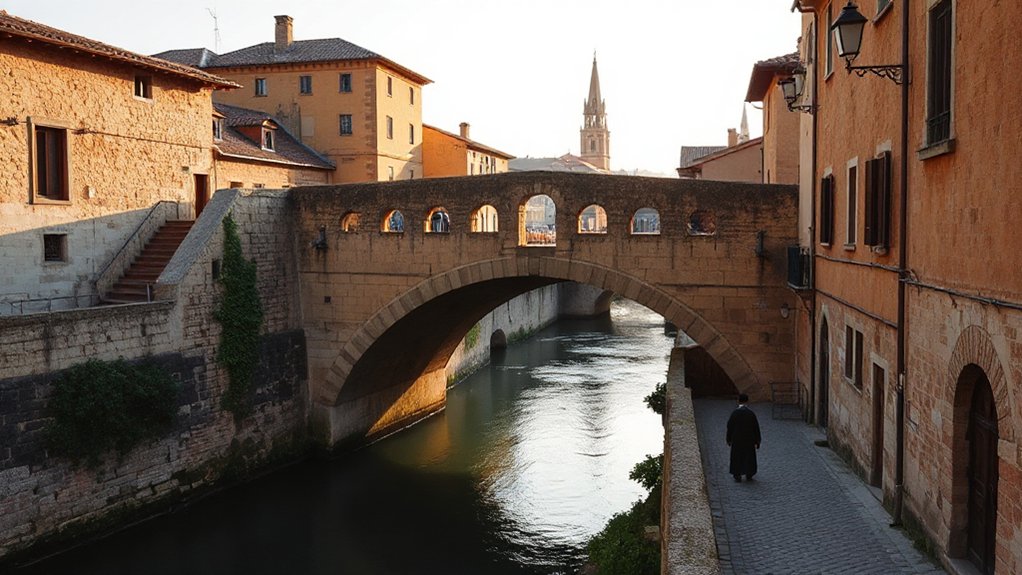
Puente La Reina sits at the threshold of the Camino de Santiago, a strategic crossing where history hinges on roadway and river. You examine how the bridge anchors a corridor of pilgrimage, trade, and memory, shaping decisions from medieval counts to modern travelers.
The town’s archival core reveals steady layering: fortifications, municipal records, and the enduring rhythm of daily life. You sense how the Pilgrim’s Gateway functioned as a visual and logistical waypoint, guiding rituals, loyalties, and routes. Its stones encode choices—bridges, inns, markets—that sustained connective momentum across centuries.
You also note how local cuisine and traditional festivals illuminate cultural continuity, turning static stones into living narrative.
- Strategic crossing as memory accelerator
- Archival threads in town fortifications
- Pilgrim logistics and daily rhythms
- Local cuisine and traditional festivals as continuity
Estella: Silk Routes and Strategic Strongholds
Estella sits at a crossroads where silk routes once stitched distant markets to local hands, and where fortress walls kept pace with shifting powers. You trace how caravans courted local crafts, turning the town into a node that linked Castilian, Navarrese, and intermediaries along a contested corridor.
The archives reveal disciplined layouts: ramparts, watchtowers, and a castle that asserted sovereignty amid fluctuating imperial claims. You note how strategic strongholds evolved from military bastions into administrative centers, shaping governance, taxation, and defense.
Silk routes linger as memory—mulberry marks, bilingual records, and trade ledgers that reveal commodity flows and seasonal rhythms. Estella’s urban fabric embodies negotiation between long-distance commerce and local autonomy, a disciplined example of adaptive resilience within a frontier landscape.
Tudela: Confluences of Culture and Cuisine
Tudela emerges at the crossroads of Mediterranean exchange and inland governance, where cultural currents mingle as readily as spices and migrants. You observe a city that keeps records in dusty ledgers and living memory, tracing how cuisine mirrors conquest, trade, and daily exchange.
You encounter markets where olives, citrus, and wine converge with grains and sausages, revealing layered identities. The archival rhythm shows rulers commissioning feasts and apprenticeships that seed local resilience.
You map Cultural festivals and local crafts as tangible evidence of integration, not novelty. You sense a city refining taste through continuity and adaptation, encoding stories in recipes, textiles, and tiles.
You leave with a discipline of curiosity, recognizing Tudela as a living archive of convergence.
- Cultural festivals
- local crafts
- markets and recipes
- architectural traces
Roncesvalles: War Legends and Camino Heritage
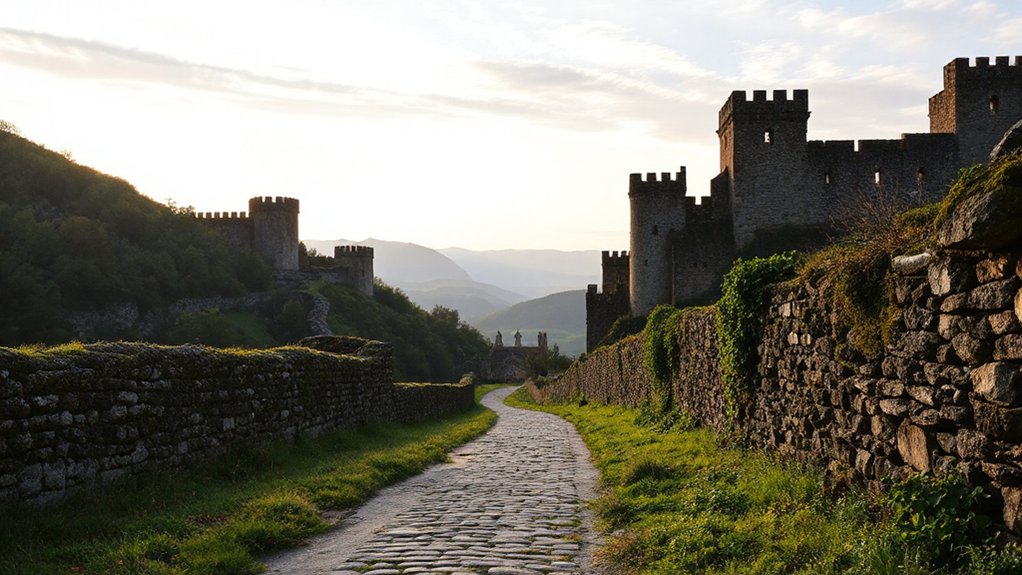
Roncesvalles stands at the hinge between legend and route, where medieval skirmishes fuse with modern pilgrimage. You enter a site where memory is catalogued like a ledger: an abbey, a pass, a marker for battles etched into stone.
The archival record reveals a constant tension between conflict and continuity, as routes widened from military lanes to pilgrim trails. You note how legends of Charlemagne’s rear-guard intersect with practical today: signage, guided tours, and careful conservation.
In the precincts, medieval music drifts from small performances, linking ritual sound with the landscape. Local life encodes history in regional cuisine, offering modest sustenance that echoes supply lines of old.
This isn’t myth alone, but a carefully observed corridor between past violence and present reverence.
Navarra’s City Defenses: Walls, Gates, and Fortresses
Behind Navarra’s urban silhouette, fortifications articulate a deliberate boundary between civic life and frontier memory; walls, gates, and bastions map a city’s defenses as much as its aspirations.
You assess how ancient walls reframe street scales, how defensive gates disciplined entry, and how fortresses imprint governance on the map. In archival detail, you trace construction phases, material choices, and restoration debates, linking masonry to policy shifts and military needs.
Contextual storytelling shows layered reuse—from watchposts to civic spaces—revealing a city’s strategy for resilience and memory. The narrative centers on function, chronology, and site specificity, avoiding romanticization while highlighting enduring urban logic.
- Ancient walls as vertical timelines of urban planning
- Defensive gates controlling movement and symbolism
- Fortresses repurposed in governance and memory
- Conservation challenges shaping future interpretation
Sacred Architecture in Navarra: Cathedrals and Monasteries
You’ll uncover how Navarra’s sacred spaces tell a layered story of power, devotion, and daily life through cathedrals and monasteries that shaped townscapes. From architectural lineage to archival records, these landmarks reveal shifting patronages, liturgical practices, and the communities that sustained them.
This introduction orients you to the core points—Sacred Architecture Highlights, Cathedrals and Monasteries, Navarra’s Spiritual Landmarks—as stepping stones for deeper archival exploration.
Sacred Architecture Highlights
Nestled among Navarra’s historic towns, the region’s cathedrals and monasteries offer a throughline from medieval practice to modern reverence, revealing how sacred spaces shaped daily life as much as liturgy did. You study their layouts, windows, and retables to trace how sacred architecture codified ritual, charity, and learning.
Monastic complexes reveal quiet economies of power, while pilgrimage routes map social networks, devotional calendars, and regional exchange. The artifacts—crypts, cloisters, scriptoria—underscore a governance of memory, where stones preserve binders of faith, politics, and education.
You read how these places directed movement, time, and perception, turning travel into encounter and reverence into practice. Sacred architecture anchors Navarra’s identity through continuity and change.
- Architectural layouts as record of daily practice
- Cloistered life shaping governance and learning
- Monastic economies tied to regional exchange
- Pilgrimage routes as social and spiritual networks
Cathedrals And Monasteries
How do Navarra’s cathedrals and monasteries reveal the daily rhythms of faith, power, and learning across centuries? You trace stone from cloister to nave, watching how construction files map political shifts alongside devotion.
In ash and ochre light, you study archival records that show patrons, masters, and apprentices shaping Gothic tracery and Romanesque solidity, a dialogue between church and crown.
You note the custody of medieval manuscripts, housed in scriptoria and later libraries, echoing scholarly routines that kept knowledge circulating through priory walls.
You examine reliquaries and religious relics as interfaces between miracle and governance, reinforcing legitimacy while guiding liturgy.
This isn’t romance but a measured chronicle: architecture recording rites, governance, and classrooms in concrete, carved detail.
Navarra’s Spiritual Landmarks
From the patterns of stone and light, Navarra’s cathedrals and monasteries reveal how sacred architecture encodes power, learning, and daily faith across centuries. You examine vaults, capitals, and cloisters as archival records, tracing how medieval spirituality shaped urban life and governance.
Monastic grids and pilgrimage routes map networks of influence, while altars and relics illuminate devotion across dynasties. You see craftsmen embodying memory in stone, wood, and metal, where local artisans sustain tradition even as styles shift.
The spaces host medieval festivals, processions, and scholarly gatherings, linking liturgy to civic identity. Contextual layers—Romanesque sobriety, Gothic ascent, Baroque refinements—reveal a continuum of meaning, not mere ornament, guiding you through Navarra’s sacred landscape.
- Architectural records of power and faith
- Monastic layouts and daily rhythms
- Medieval festivals and processions
- Local artisans sustaining a living heritage
Medieval Market Life: Plazas, Guilds, and Food Traditions
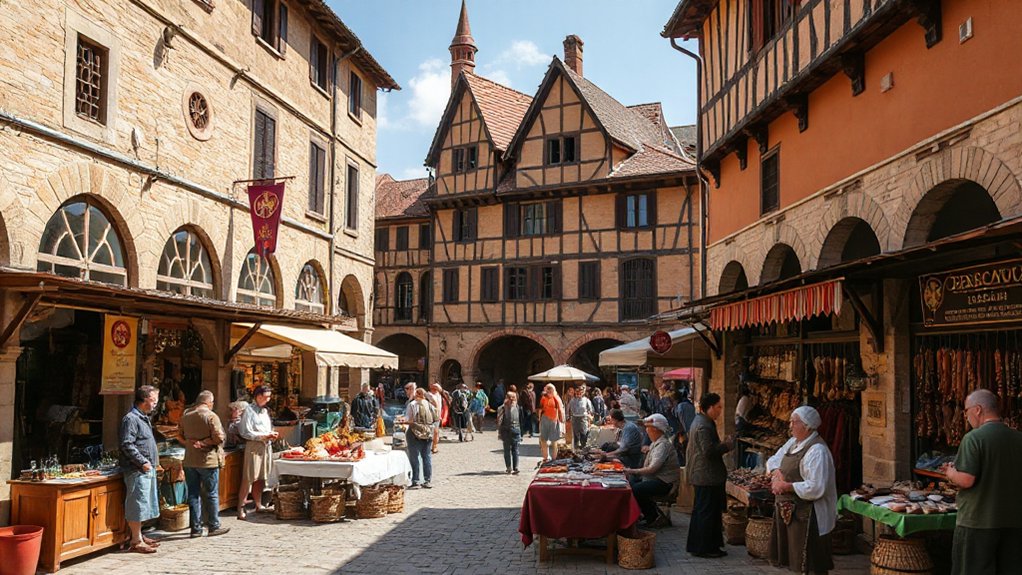
Markets in Navarra’s medieval towns thrived where plazas met guild halls, weaving daily life into a rhythm of trade, regulation, and ritual. You observe how a medieval market organized space, branding stalls by craft, price bands, and oath-bound guild oversight.
Records show weekly fairs synchronized with religious feast days, reinforcing social bonds and reciprocal obligations. You note the input of bakers, butchers, bakers, and spice merchants, each constrained by sumptuary rules that defined status through goods.
Food traditions emerged as both sustenance and signal, with seasonal produce, salted ham, and honeyed ale shaping shared memory. You track how plaza benches became negotiation rooms, councils drafting ordinances that stabilized prices and settled disputes, preserving continuity amid shifting lordships.
The archival detail reveals living mechanisms of urban culture.
Rivers, Valleys, and Urban Mood Across Navarra
Rivers study Navarra’s urban mood as living arteries, shaping routines, values, and the silhouette of cities from Pamplona to smaller river towns. You read how water sculpts districts, floodplain economies, and seasonal rhythms, leaving archival traces in bridges, mills, and markets. Valley landscapes frame civic identities, guiding settlement choices, transport lanes, and even festival timing.
You note that river ecology governs flood management, freshwater sources, and habitat diversity, linking urban life to upstream decisions. This creates a layered narrative where memory meets planning, and cities reveal their adaptive strategies through care for streams, banks, and levees.
- River ecology shapes infrastructure decisions and daily routines
- Valley landscapes influence settlement patterns and transport networks
- Floodplain management preserves both heritage and continuity
- Waterways anchor cultural memory across Navarra’s towns
Traces Along the Camino: Pilgrimage Routes Through Cities
Along Navarra’s streets, the Camino leaves an afterimage in stone and footsteps, tracing routes where pilgrims once converged with locals at gates, inns, and parish churches. You track how routes stitched together regions, evolving from rugged paths to legible urban traces, each city recording a moment of arrival.
An archival lens reveals inscriptions, faded milestones, and parish maps that guide your sense of movement across time. You note the interplay between modern architecture and traditional thoroughfares, where glass façades sit beside stone arches, signaling adaptation without erasing memory.
Culinary traditions emerge as social waypoints—taverns, markets, and bakeries where stories mingle with sustenance. The pilgrimage, you realize, is less a line than a braided urban chronicle.
Planning Your Historic Navarra Tour: Practical Itinerary Tips
Begin with a practical arc: map a feasible two-to four-day loop that centers Navarra’s historic cores—Pamplona, Olite, Estella, and Tudela—while allowing pauses for arches, markets, and parish churches that anchor each city’s memory.
You’ll balance archival detail with present-day pacing, noting how streets preserve layers of rule, trade, and faith. In Pamplona, track medieval walls before savoring local cuisine; in Olite, study the palace precinct and its ceremonial ghosts; Estella’s bridges reveal continuities; Tudela anchors harvest traditions.
Plan around traditional festivals and seasonal markets to experience living history as you go. This isn’t rush, but informed immersion, aligning transport, stays, and stops with memory and meaning.
- Practical routing and pacing
- Archival anchors in each core
- Timing for markets, arches, churches
- Local cuisine and traditional festivals integration
Frequently Asked Questions
How Did Navarra’s Cities Influence Regional Language Development?
Your cities shaped medieval language evolution by fostering trade, courts, and schools, where regional dialect influences merged with Latin traces, creating layered scripts. You observe archival records, noting urban centers as catalysts for evolving vocabularies, pronunciation shifts, and syntactic blending.
Which Lesser-Known Fortresses Guard Navarra’s Medieval Borders?
Thousands slept under siege drums; you’ll discover, in Navarra, hidden medieval border defenses like Olite’s overlooked outposts and Tudela’s distant guarda forts. Their ancient fortress towers guard quiet thresholds, revealing archival whispers and strategic lessons about frontier resilience.
What Daily Life Existed in Historic Navarra Markets?
You observe daily life in historic Navarra markets as locals barter, trade, and socialize. You note local market traditions shaping routines, while daily market activities reveal how merchants organized stalls, payments, and deliveries within enduring archival rhythms and social networks.
How Did Pilgrim Routes Shape Urban Layouts?
Pilgrimage influence shaped urban layouts as routes funnelled markets, gates, and inns toward holy sites. You see how pilgrims redirected traffic, fueling density around monasteries, churches, and plazas, guiding urban planning with archival clarity and contextual storytelling.
Where Are Hidden Architectural Gems off the Main Trails?
Hidden courtyards beckon you beyond bold boulevards, revealing secret alleyways where time Tangos with stone. You analyze archives, tracing whispers of walls, noting concealed arches, hidden courtyards, and secret alleyways that quietly shape Navarra’s nocturnal narratives.
Conclusion
You’ll finish with a soft, careful sense of Navarra’s past, not a loud finale but a careful inventory of echoes. The cities whisper their complexities—stone that shields and opens, markets that hum with old guild rhythms, rivers that shape moods without shouting. By tracing the paths between Roman roots, royal quarrels, and pilgrim steps, you’ve read history as a living archive, gently updated, quietly insisting that every stone invites further reflection. The journey lingers, respectfully unfinished.