
If you’re chasing iconic Extremadura, start in Mérida to walk Roman streets where mosaics gleam and state-of-the-art amphitheaters echo ancient crowds. Then pace up to Guadalupe Monastery, its white walls catching dawn light and its cloisters whispering quiet power. Lose yourself in Cáceres Old Town’s medieval maze, then glimpse Trujillo’s plaza and castle bathed in sunset. Don’t miss Plasencia Cathedral’s Gothic spine and the Provençal charm of San Martín de Trevejo. More names and routes await you ahead.
Key Takeaways
- Mérida’s Roman Theatre and Amphitheatre, plus the aqueducts and forums, anchor Extremadura’s ancient heritage.
- Guadalupe Monastery towers over the hills with its whitewashed walls, cloisters, and sacred artistry.
- Cáceres Old Town and Trujillo combine medieval labyrinths, towers, and scenic plazas for atmospheric exploration.
- Monfragüe National Park offers dramatic cliffs, rivers, and raptor-viewing viewpoints like Puerta de la Virgen.
- Plasencia Cathedral and Old Quarter fuse Gothic and Renaissance elements with panoramic sunset viewpoints.
What Makes Extremadura’s Landmarks Iconic
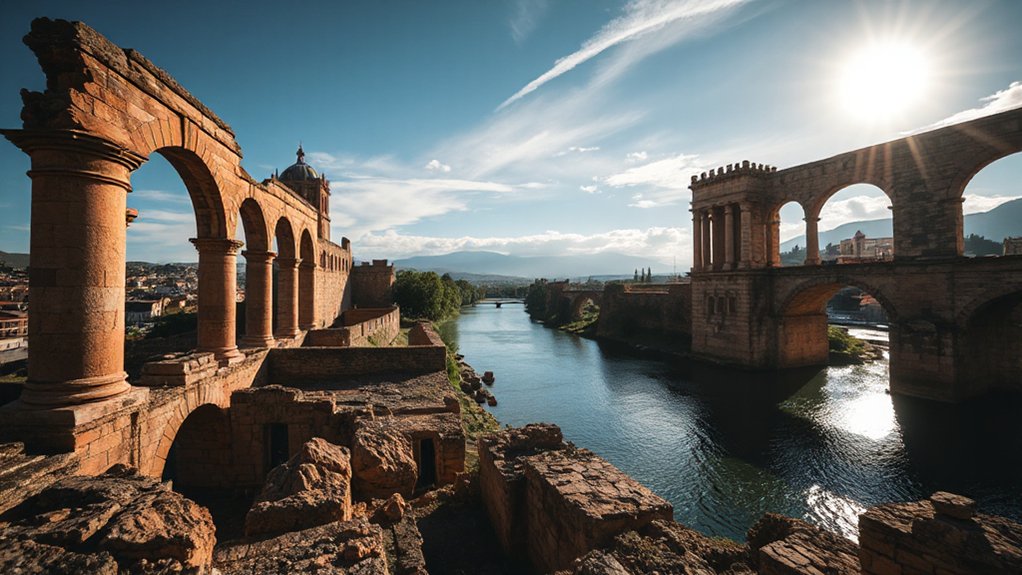
From the moment you glimpse Extremadura’s landmarks, you feel a stubborn clarity: history isn’t a museum display here, it’s the air you breathe. You’ll sense iconic power in sun-bleached arches, carved stones, and horizons that line up with centuries of craft.
What makes them iconic isn’t flash—it’s the way every site tells a region’s story without shouting. You walk a practical route: start at a hilltop sanctuary, descend to a medieval quarter, then circle to a hill fort that overlooks winding valleys.
Cultural festivals infuse the experience with music, color, and ritual, while Local cuisine anchors memory in every bite. The landmarks endure because they’re lived-in, navigable, and continually renewing the place you’re visiting.
Emerita Augusta: Roman Ruins and Timeless Remnants
Step into Emerita Augusta and pace along Roman Ruins Timelines that whisper of emperors, baths, and stone mosaics under open skies.
You’ll map a practical itinerary—starting at the amphitheater, lingering at the forum, and ending with a sunset stroll by the aqueduct—feeling time unfold in each timeless remnant.
Let these Emerita Augusta Highlights spark your curiosity, inviting you to trace ancient routes and imagine bustling streets still echoing with footsteps.
Roman Ruins Timelines
Emerita Augusta unfolds like a living timeline, where marble streets and stone outlines map the city’s rise from a provincial outpost to a bustling capital. You walk the stone pavement and feel epochs underfoot, tracing walls that once hosted emperors and silver-tlecked markets.
Begin at the theater, where seating curves mirror civic pride, then follow the forum’s axis toward baths that once pulsed with steam and conversation. Along the way, you notice Ancient aqueducts threading the hills, delivering water as if time itself were a constant procession.
Pause at the temple precinct to study Roman mosaics, tessellated whispers of traders’ stories. In a tight afternoon arc, you’ll see layers piling into a coherent, living map of power, trade, and memory.
Timeless Amble Through Remnants
Emerita Augusta invites you to linger on a gentle path through its enduring whispers. You step along ancient stones, where faint echoes of wheels and footsteps guide your pace.
The Roman ruins unfold in layered light: a forum’s outline, an amphitheater’s hush, a colonnade catching sky like a breath held too long.
You map a practical circuit: begin at the museum, then cross to the archaeological site, pause beside the restored baths, finish near the Roman bridge as sunset paints brick and stone.
Cultural festivals spill into the streets, inviting you to join with music and shared stories, while traditional crafts line market stalls, aldeas of skill you can watch and purchase.
Timeless remnants anchor your day, rewarding curiosity with tangible history.
Emerita Augusta Highlights
A vivid thread through time, Emerita Augusta unfurls its Roman heart with walkable clarity: start at the museum to orient, then drift toward the archaeological site where columns rise like quiet sentinels.
You’ll map the forum first, then trace the curving streets toward ancient mosaics that catch light with every step. Pause at the semicircular theater, feel the stone imprint of crowds long gone, and imagine debates under the open sky.
Follow the remnants of the Roman aqueducts, still bold enough to hum with history as you approach the baths. Pack water, wear good shoes, and let the ruins cue a concise, immersive loop through memory and stone.
Return via the museum gallery, where time settles into quiet, tactile clarity.
Guadalupe Monastery: Spain’s Spiritual Powerhouse
Nestled high in the Sierra de Guadarrama-like hills of Extremadura, Guadalupe Monastery rises as a beacon of faith and endurance, where centuries of devotion sharpen the air and memory alike. You enter through whitewashed walls, map in hand, and feel spiritual retreats breathe from every doorway.
The church’s religious architecture commands your gaze: pilasters, intricate carvings, and a vaulted ceiling that seems to lift your thoughts skyward. Plan a dawn visit, then wander the cloisters, listening for bells that echo pilgrims’ footsteps.
Bring a compact itinerary: short climb to the surrounding groves, a quiet prayer in the chapel, and a final courtyard pause with a cup of hot cocoa. Transparent, brisk, and sincere, Guadalupe rewards focus and patience.
Cáceres Old Town: A Living Medieval Labyrinth
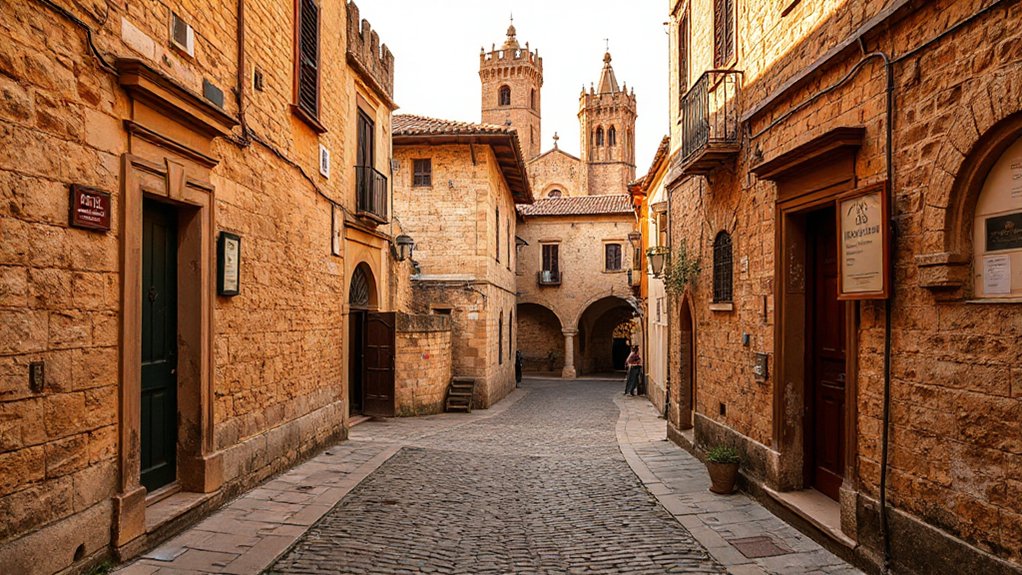
Wander Cáceres Old Town and step into a medieval labyrinth of narrow walkways that feel carved from memory. You’ll march between timeless stone architecture, where every corner reveals a new doorway, a quiet courtyard, or a sunlit alley to map for your afternoon.
Start your route in the untouched old town core, then weave through the maze of streets to feel history unfolding at every turn.
Medieval Labyrinth Walkways
From the moment you step into Cáceres Old Town, the labyrinthine walkways pull you through a living medieval maze, where narrow alleys fork like veins and every stone bears a story. You’ll notice medieval walkways guiding your pace, turning corners with purpose.
Follow the cobbles to the Torre de Bujaco for a rooftop view, then descend through arches that frame sunlit courtyards. Pause at a local tisana stand and let the scent anchor you.
For a practical route, start at the Puerta de Jerez, weave toward the Plaza de Santa María, then lose or find yourself along labyrinth pathways that reveal quiet plazas and hidden courtyards.
Move deliberately, photograph textures, and let history unfold with each step.
Timeless Stone Architecture
Cáceres Old Town is a living gallery of timeless stone, where each wall bears the weathering of centuries and every doorway invites you to step into a story. You navigate narrow lanes, tracing crenellated silhouettes that rise like cliffs of memory.
Focus on the core blocks where Ancient inscriptions catch the light, revealing names and dates carved by hands long gone. Follow a practical loop: start at the Plaza Mayor, slip into the maze of the Jewish Quarter, then descend toward the city walls for sunset views.
You’ll notice Architectural preservation in every restored arch and intact doorway, proof of careful stewardship. Move briskly yet reverently, collecting impressions as if they’re relics you can wear.
Untouched Old Town Core
Your first stop is the Arco de la Estrella, then into shadowed plazas where sunlight sparkles on whitewashed walls. Follow the narrow routes to hidden alleyways that pulse with history, then ascend to viewpoints that frame Cáceres’s red-tiled roofs like a painted crown.
Pause at local artisan shops to touch carved wood and woven textiles, listening to craft stories.
For a practical loop, start at Plaza Mayor, weave toward the Old Cathedral, then descend via the subterranean lanes back to the city’s heartbeat.
Trujillo: Plaza Mayor and the Castle in Focus
Nestled in the heart of Trujillo, the Plaza Mayor and the medieval castle rise as twin sentinels of history, inviting you to step into centuries of shadowed arcades and sunlit towers. You begin beside the square, tracing stone arcades that pulse with life, then swing toward the castle keep, where each battlement frames a blue sky.
Follow a practical route: linger on the Plaza Mayor at dawn, sip coffee, then climb the castle stairs for sweeping views. Descend to the Torre de Doña Blanca for panoramic vantage points, and stroll along the old walls to discover scenic viewpoints that meet you at every turn.
The experience centers on medieval architecture and the quiet drama of stone and sky.
Monfragüe National Park: Cliffs, Birds, and Panoramic Vistas
Monfragüe National Park unfolds as a cathedral of crags and skies, where sheer cliffs plunge over turquoise streams and raptors wheel on thermals above ancient oaks. You stroll the well-marked paths, spotting griffon vultures riding updrafts and golden eagles surveying the gorge.
Plan a dawn ascent to the viewpoints near Castle’s shadow, then descend to the riverside trails where iberian ibex leave quiet footprints. Bring binoculars for intimate encounters with colony swifts and shy blue rock thrushes; respect bird conservation norms to keep the site pristine.
For dramatic panoramas, follow the mirrored river to the Puerta de la Virgen overlook, or chase sunset colors from Las Peñas viewpoint. Panoramic viewpoints reward you with sweeping contrasts of stone, sky, and water.
Mérida’s Archaeological Treasures: Theatre, Amphitheatre, and Beyond
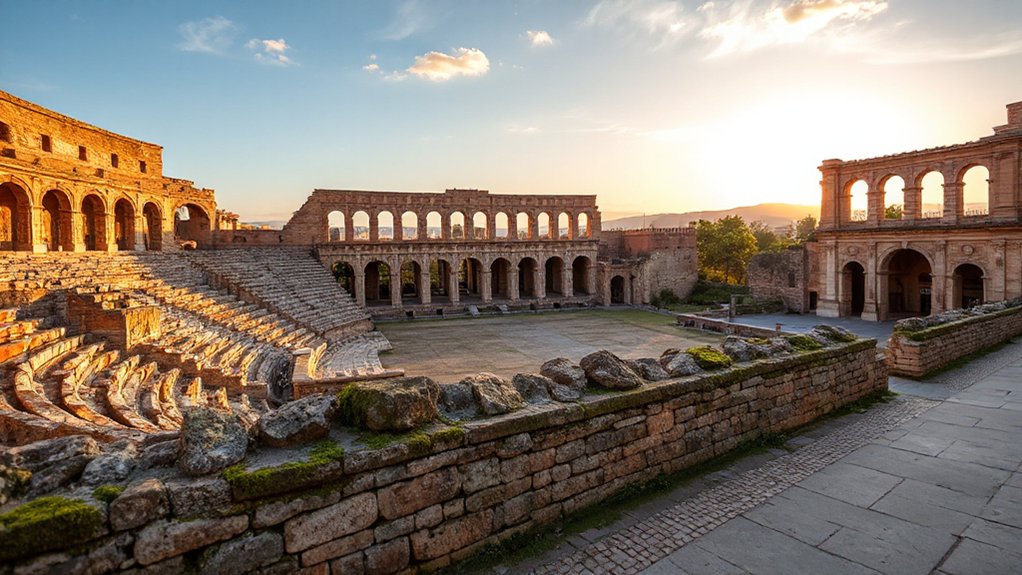
Mérida’s archaeological treasures unfold like a living timeline, where stone walls echo with centuries of drama and everyday life. You step into the Theatre, feel the stone sigh under your steps, and picture a chorus of citizens carving out evenings of cultural festivals.
Walk the surrounding arena at a measured pace, imagining the roar of crowds as spectacles unfurl below the sky. Cross to the Amphitheatre, where Ancient artifacts whisper of emperors and games, and you measure the echoes with your own breath.
Pause at the museum for a compact, focused glance, then map a tight loop: Roman bridges, baths, and forums within easy reach. Return with memories sharpened, plans for another, more focused, visit.
Guadalupe: Monastery Cloisters, Quiet Grandeur, and Art
Guadalupe unfurls in quiet grandeur, where the Monastery’s cloisters frame a hush that seems to slow time itself. You step beneath stone arches and feel history tighten like a tether, guiding you toward art that still breathes.
In the cloister’s shade, you trace medieval monasteries’ quiet disciplines, then ascend to the sacristy and chapel, where frescoes glow with careful, mortal light. This is a place for spiritual retreats, a pause that steadies breath and invites reflection, not spectacle.
Plan a morning courtyard walk, then a guided tour of the treasury, followed by a late afternoon at the basilica’s sacred tunes. Pack comfortable shoes, water, and a notebook to capture the reverent details you’ll carry afterward.
Plasencia Cathedral and Old Quarter: Gothic Meets Renaissance
You wander into Plasencia’s Gothic-Portico splendor first, tracing pointed arches that frame the sky like a drawn cathedral blueprint.
Then you step inside to feel Renaissance refinements within—soft friezes, balanced lines, and light that breathes across stone.
Plan a practical stroll: start at the cathedral, loop through the Old Quarter, and let the contrast guide your pace from medieval shadows to refined daylight.
Gothic-Portico Splendor
As you step into Plasencia Cathedral and wander its Old Quarter, the Gothic spine of the city reveals itself in soaring arches, delicate rib vaults, and a stonework that seems to breathe with history.
Then softens into Renaissance touches that quietly update the skyline. You’ll trace a clear sequence: nave to chapel, tracery to silence, where Gothic architecture defines the sense of place.
Let the Portico design guide your route—approach the grand portal, study its sculpted tympanum, and notice how light filters through slender columns.
Pause on the plaza, then loop toward the cloister, listening for merchants and bells.
In under two hours, you’ll experience the cohesion of stone, shadow, and craft that makes this cathedral a living itinerary.
Renaissance Refinements Within
Renaissance refinements quietly thread through Plasencia Cathedral and its Old Quarter, turning stone into a diary of light and refinement. You’ll feel Renaissance architecture breathe alongside Gothic tracery, as corridors tighten into precise lines and color blooms in the façade.
Step into the cloister, where artistic craftsmanship reveals itself in carved capitals and delicate arches. Bring a map, pace yourself, and let the sun sketch gold along the nave.
- Trace the rhythm of arches from doorway to choir, noting how the Renaissance gaze softens Gothic weight.
- Pause at the stairwell landing to study carved motifs and the seam where chapel and street meet.
- End by a sunset overlook of the Old Quarter, letting the harmony of stone guide your memory.
San Martín De Trevejo and Nearby Villages: Provençal Charm on the Border
Tucked along the border with Portugal, San Martín de Trevejo feels like a Provençal pocket carved into Extremadura, where whitewashed walls glow under sunlit skies and narrow lanes wander between shuttered houses and buzzing markets.
You wander through Provençal architecture that mingles granite and tile, catching sun on balconies as bells toll from a hillside chapel.
Nearby, nearby villages unfold in a mosaic of vineyards, cobblestones, and lace-curtained windows, each offering a bite of Border traditions—savory cheeses, smoky chorizo, and dulcet pastries.
Savor a hillside terrace, trace an old mule path to a panoramic lookout, then descend to a square where locals trade news with a quick, friendly smile.
Plan a half-day loop to immerse, then linger for sunset over terraced hills.
Practical Planning for Extremadura: Routes, Timelines, Tickets, and Tips
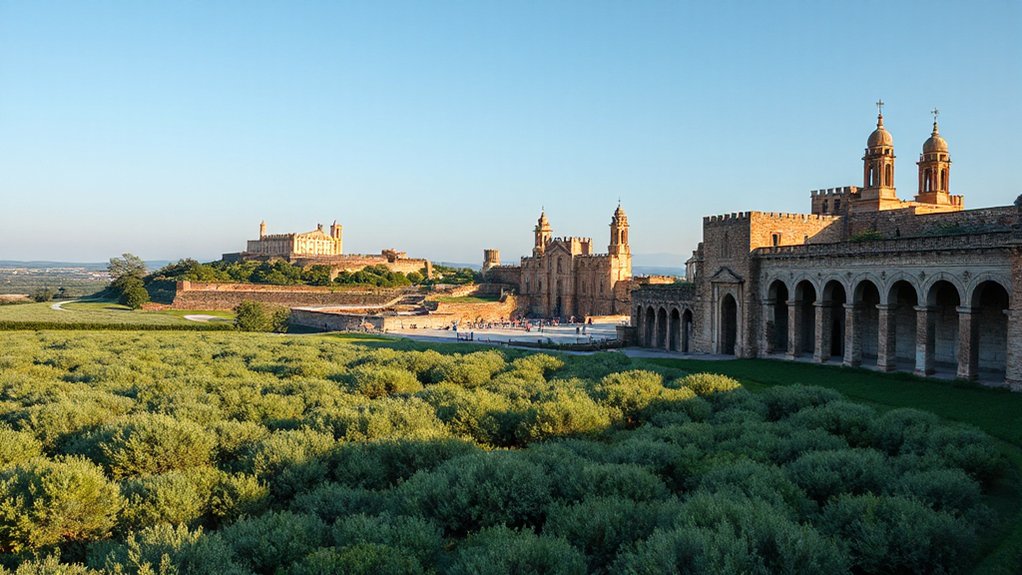
To make the most of Extremadura, map a realistic route that pairs must-see landmarks with time for slower moments on sunlit plazas and hillside viewpoints. Start by choosing a base city—Cáceres, Mérida, or Plasencia—and plot a logical loop that minimizes backtracking. You’ll balance history with bites of local culture, budgeting for practical logistics like tickets, opening hours, and travel accommodations.
- Plan ticketing windows early—some sites offer timed slots and combined passes.
- Schedule meals around regional local cuisine, sourcing taverns near landmarks for maximum flavor and efficiency.
- Reserve a flexible pace that includes a sunset overlook and a relaxed café stop.
Keep maps handy, carry water, and adjust timelines for weather to preserve energy.
Frequently Asked Questions
What Are the Best Times of Year to Visit Extremadura Landmarks?
Spring and fall are best for Extremadura landmarks, you’ll avoid peak heat and crowds. Enjoy seasonal festivals, mild Weather considerations guiding outdoor routes, friendly crowds. Pack layers, plan morning starts, and savor sunset viewpoints along practical itineraries.
How Long Should You Allocate for a Regional Highlights Tour?
You’ll want about 3 days for a regional highlights tour, pacing like a storyteller. Picture a map as a road-lit river, weaving local culinary stops and outdoor activities into a vivid, practical itinerary you can follow comfortably.
Which Landmarks Are Most Kid-Friendly or Family-Oriented?
You’ll find family-friendly options like kid-friendly museums and castle grounds with picnic spots, plus kids’ activity centers nearby, so plan an outdoor morning, a relaxed lunch at a family picnic spot, and an afternoon castle tour.
Are There Any Entry Fees or Timed Ticket Requirements?
Yes—ticket policies vary by site, with some requiring timed entries and others walk-ins; always check official pages. You’ll encounter entry restrictions at certain hours, so plan early, book ahead if possible, and carry ID.
What Local Transport Options Connect Major Sites Efficiently?
Like a spiderweb of threads, you’ll ride local bus services between sites, and taxi availability fills gaps. You’ll chart practical itineraries, leveraging buses for core sites and taxis for last-mile hops between monuments and viewpoints.
Conclusion
You’ll leave Extremadura with a soft-spoken astonishment, as if a delicate hush lingers after you’ve pressed through its doors. The landmarks merely invite you to linger longer, not to rush ahead. Savor the echo of ancient stones, the quiet cloisters, the sunlit plazas, and winding lanes that hint at timeless stories. Plan a gentle arc: a few days, measured routes, mindful tickets, and a twilight coffee that seals memories with a warm, tender, almost-unsaid farewell.