
Flamenco’s soul emerges from a living dialogue among cante, toque, and baile, a dynamic exchange that blends Gypsy, Andalusian, Moorish, and Afro-Czech roots into a passionate, improvisational art shaped by place and community. You’ll hear deep cante jondo’s longing, intricate guitar rasgueado, and dance that literalizes emotion through rhythm and gesture. Palos map moods and history, while performance spaces, costumes, and festivals keep heritage vibrant. If you keep exploring, you’ll uncover how performance negotiates identity and tradition.
Key Takeaways
- Flamenco blends Gypsy, Andalusian, Moorish, and Afro-Czech influences to express deep emotion through cante, toque, and baile.
- The core is compás and improvisation, where rhythm, phrasing, and microtonal inflections convey longing and resilience.
- Cante jondo emphasizes primal sorrow, transforming personal pain into communal memory within southern Spain’s social history.
- The trio’s interdependence—cante, toque, baile—creates a dynamic cultural dialogue that shapes mood, storytelling, and identity.
- Modern flamenco evolves through fusion with other genres and technologies while preserving tradition and emotional core.
What Flamenco Is: Origins and Core Elements

Flamenco is a complex, layered art form rooted in a fusion of Gypsy, Andalusian, Moorish, and Afro-Czech influences, yet it remains centered on emotion, rhythm, and improvisation. You explore its origins as a fluid dialogue among song, guitar, and dance, not a fixed repertoire.
Core elements emerge through compás, tonality, and phrasing, where guitar rasgueados, palm-stomps, and vocal inflections synchronize to create a living pulse.
Flamenco symbolism surfaces in gestures, color, and space, conveying states from longing to defiance, while performers negotiate memory, lineage, and personal witness within a communal frame.
Cultural significance grows as audiences reinterpret performance as record, ritual, and social expression.
You recognize it as an evolving craft linked to place, history, and identity, not a static tradition.
The Cante, Toque, and Baile: The Flamenco Trinity
The cante, toque, and baile form a dynamic trio that defines Flamenco from the inside out, each aspect shaping and responding to the others in real time. You enter a performance as an experiential triad, where song dictates tempo, guitar colors momentarily shape emotion, and movement crystallizes meaning.
The cante provides emotional contours—expression, restraint, or improvisatory surge—while the toque negotiates rhythm with intricate falseta and compás, guiding dancers toward or away from tension.
Baile translates that conversation into posture, steps, and timing, making narrative visible.
Contextually, you’ll notice how Flamenco costumes accent line and gesture, reinforcing character and mood, and how Flamenco festivals curate spaces for this exchange.
The Trinity remains both discipline and spontaneity, a living framework for regional heritage and personal interpretation.
Flamenco Cante Jondo: Deep Song and Longing
Cante jondo emerges from the same roots as the cante, toque, and baile, but its core lies in an unguarded, almost primal, expression of sorrow and longing.
You hear a stark, even tremulous quality in the voice, a technique that prioritizes restraint, microtonal inflections, and a gravity that lingers after each phrase. This singing style encodes ritual emotion, turning personal pain into communal memory, a process of transmission through generations.
You notice how technique—breath control, cadence, vibrato—becomes a vehicle for cultural symbolism: symbols of exile, grief, and resilience embed themselves in every note.
Contextually, cante jondo stands as testimony to southern Spain’s social history and collective identity, inviting you to listen beyond surface ornamentation into deeper, shared meaning.
Flamenco Guitar: The Toque and Improvisation
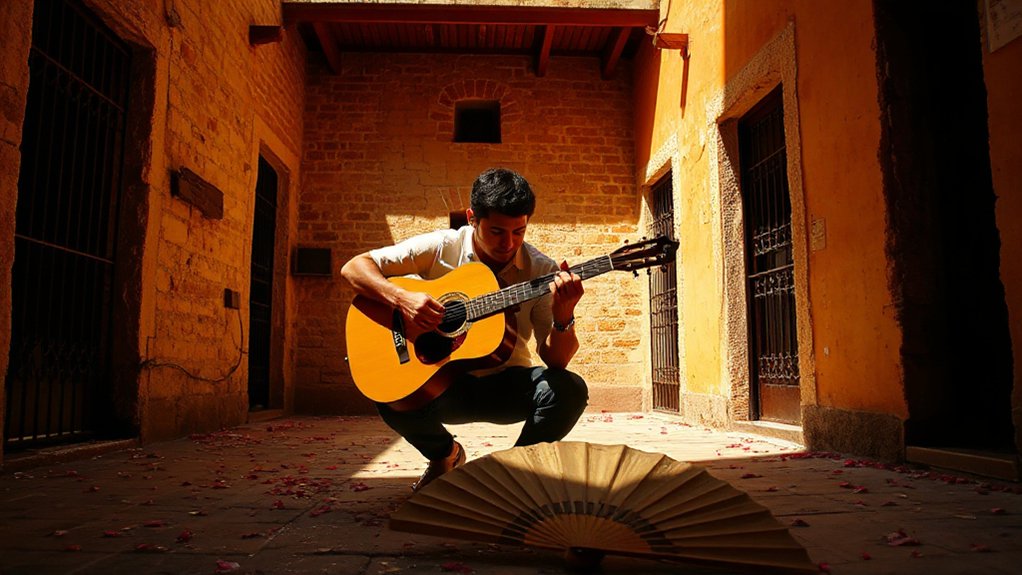
You explore how the toque weaves Flamenco guitar techniques into a living groove, where precision and feel meet improvisation.
You feel the pulse of the rhythm, the call-and-response with Palmas guiding timing and tension.
You observe how improvisation hinges on form, context, and the guitarist’s dialogue with canta and baile.
Flamenco Guitar Techniques
Flamenco guitar, or toque, blends precise technique with expressive improvisation, where players shape melodies directly from the pulse of the dance and cante. You’ll notice how technique underpins emotion: rapid rasgueado bursts contrast with delicate picado lines, while tremolo and golpe add percussive color to pin down rhythm.
The approach emphasizes restraint paired with fiery impulsivity, so you learn to listen before you attack. In practice, innovative techniques emerge from necessity—snapping dynamics, selective rasgueos, and right-hand precision drive character across styles.
You’ll also encounter fingerpicking patterns that interlock with the guitar’s bass drone, creating a steady foundation for melodic elaboration. Mastery hinges on nerve, timing, and a refined touch that lets improvisation stay rooted in structure, tradition, and the cantos that inspired it.
Toque Improvisation Rhythm
Toque improvisation thrives on rhythm as a living framework, not a fixed script. You engage by sensing subtle timing cues and weaving spontaneous responses into established cadences, maintaining dialogue with the cant of the room.
As in flamenco, improvisation techniques hinge on listening: you watch the singer, the dancer’s footwork, and the guitarist’s own pulse to momentarily align or dare contrast. The result is a descending-into-ascending flow where phrasing twists and resolves within a shared metric.
Rhythmic complexity emerges from cross-rhythms, sesquialabras, and accelerando gestures that push a barline without breaking mood. This discipline rewards precision and restraint, transforming uncertainty into expressive momentum while preserving the genre’s ceremonial cadence and emotional gravity.
Groove, Palmas, And Pulse
The toque moves between fixed cycles and improvised deviations, so your playing must anticipate clave-like accents while honoring syncopation and phrasing. Palmas supply a metrical skeleton, yet their nuance—timbre, volume, golpe—inflects pulse direction.
You notice rhythmic complexity arising from cross-rhythms, hemiolas, and subtle accelerations, demanding precise coordination with dancers and singers. Percussion patterns reinforce structure without stifling spontaneity, enabling expressive improvisation within tradition.
The result is a communicative cadence, where technique serves emotion and heritage.
Palos, Rhythms, and the Flamenco Canon
Palos, or flamenco styles, organize the music around distinct rhythms, moods, and structures, anchoring improvisation, singing, and dancing into a coherent canon. You’ll notice how each palo encodes social emotion and narrative, shaping moments of collective breath and individual gesture.
The Flamenco canon emerges from a dynamic grammar: fixed compasses, accented syllables, and cadences that invite personal interpretation without breaking tradition. You assess how rhythm sustains emotional tension, while melodic lines encode subtler meanings—Flamenco symbolism surfaces in the interplay of voice, guitar, and heel.
You see how emotional expression is distributed across palos, yet harmonized within a performance’s arc, guiding improvisation, audience response, and memory. Contextual understanding reveals lineage, mournfulness, joy, and resilience embedded in this living, stylistic map.
Geography of Flamenco: Andalusia as Stage
Andalusia isn’t just a backdrop for flamenco; it shapes the music, dance, and memory through its landscapes, towns, and histories. You observe how geography routes emotion: the river valleys channel longing, the hills shelter improvisation, and coastal winds carry improvisational echoes into courtyards and taverns.
This landscape becomes a stage where Flamenco symbolism translates place into gesture—fingers striking air, arms tracing horizons, feet marking time like distant footfalls on stone paths. You notice festivals unfolding across cities, from intimate patios to grand theaters, where Andalusian festivals fuse tradition with innovation, reinforcing communal memory and performance conventions.
The geography isn’t passive; it constrains and liberates, guiding repertoire, timing, and mood while embedding the genre within regional identity.
Gitanos and Other Voices: Communities That Shaped Flamenco
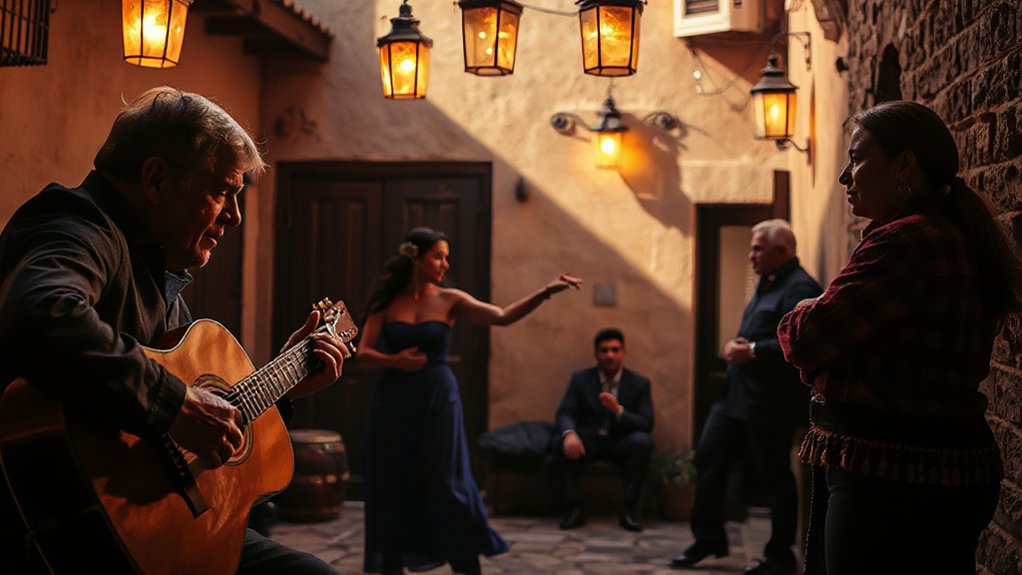
Gitanos, along with other marginalized voices, have been the pulse and pressure points of flamenco, shaping its rhythms, phrasing, and expressive range. You assess how communities contributed distinct textures—cantos, palmas, and dance gestures—that fused into a shared repertoire.
Gitanos’ influence resonates through song forms and improvisational cues, showing resilience amid social exclusion. You note how respected cantaors, bailaoras, and guitarrists drew from gypsy, Andalusian, Sephardic, and Afro‑Andalusian sources, weaving a tapestry of technique and emotion.
Cultural diversity within flamenco became a proving ground for adaptability, experiment, and negotiation with audiences. In this light, you see flamenco not as a singular lineage but as a living conversation, where marginalized voices expanded expression, challenge, and meaning.
From Gypsy Roots to a Pan-Style Art Form
You encounter how Gypsy roots thread through flamenco’s core, shaping its emotional language and rhythmic spontaneity.
As the tradition expands, you see a pan-Style evolution emerge, drawing from diverse musical textures and performance practices.
This shift invites you to assess how heritage informs contemporary expression without losing the power of its Gypsy origins.
Gypsy Roots Influence
The Gypsy roots of flamenco trace a winding influence across styles and regions, blending Arab, Jewish, and Romani musical gestures into a shared language of passion and improvisation.
You trace how Gypsy influence threads through cante, toque, and baile, turning isolated motifs into a living dialogue.
The result is a layered tapestry, where maqam inflections, bulería swing, and song-embedded storytelling coalesce into a flexible idiom.
You observe cultural fusion at work, not as a collision but as a negotiation that honors origin while inviting experiment.
Context defines meaning: venues, social codes, and performance spaces shape choices, making each rendition a negotiation of identity.
In this light, flamenco emerges as a resilient, evolving conversation rather than a static tradition.
Pan-Style Evolution
From the Gypsy-rooted threads, flamenco expands into a pan-style art form by absorbing regional idioms without surrendering its core spontaneity. You observe how communities adapt repetition and phrase structure, blending local cues with the genre’s pulse.
This pan style evolution isn’t uniform; it’s a dialogue between tradition and innovation, where tablaos, fiestas, and tarantas each contribute distinctive accents. You note how rhythmic improvisation becomes a unifying thread, allowing performers to weave personal expression into shared forms.
The result is cohesion without stasis: familiar motifs reinterpreted through varied tempos, claps, and palmas. Contextually, the expansion reflects mobility, cultural exchange, and evolving audiences.
You still sense a core, though, intrinsic energy that keeps flamenco responsive, immediate, and emotionally charged across geographies.
History in Performance: Resilience Through Expression
Performance has long served as flamenco’s most direct testimony to resilience, translating collective memory into movement, song, and rhythm. You witness how a performance curates history through intensity, cadence, and deliberate repetition, shaping an archive that lives beyond pages.
In southern Spain, the stage becomes a forum where cultural resilience is voiced not through statuary but through improvisation anchored in tradition, allowing communities to reflect on hardship, triumph, and migration. Expressive storytelling unfolds in you as you watch a singer, guitarist, and dancer negotiate tension, release, and communal breath.
The history embedded in these gestures invites interpretation, situating resilience within improvisational dialogue rather than fixed chronology, and underscoring how performance preserves memory while inviting fresh meaning for each generation.
Dance as Narrative: Palmas, Movement, and Structure
Palmas, or handclaps, scaffold the flamenco narrative as much as the dancers’ feet, shaping tempo, emphasis, and dialogue. You feel how rhythmic storytelling emerges from pulse, accented hits, and call‑and‑response between claps and steps.
Movement becomes argument, gesture a shorthand for longing, defiance, or joy, each phrase building the plot of the performance. The structure—cantes, baile, and toques—works like chapters, each section heightening tension before a decisive, expressive gesture or pause.
You observe how timing, spacing, and weight of the body translate emotion into memory, making the story legible beyond language. This is analytic craft in action: technique serving meaning, performance revealing culture through motion and sound.
- Rhythmic storytelling as explication of emotion
- Expressive gestures signaling turns in the tale
- Claps, steps, and pauses shaping narrative arcs
Place, Community, and Tradition Today
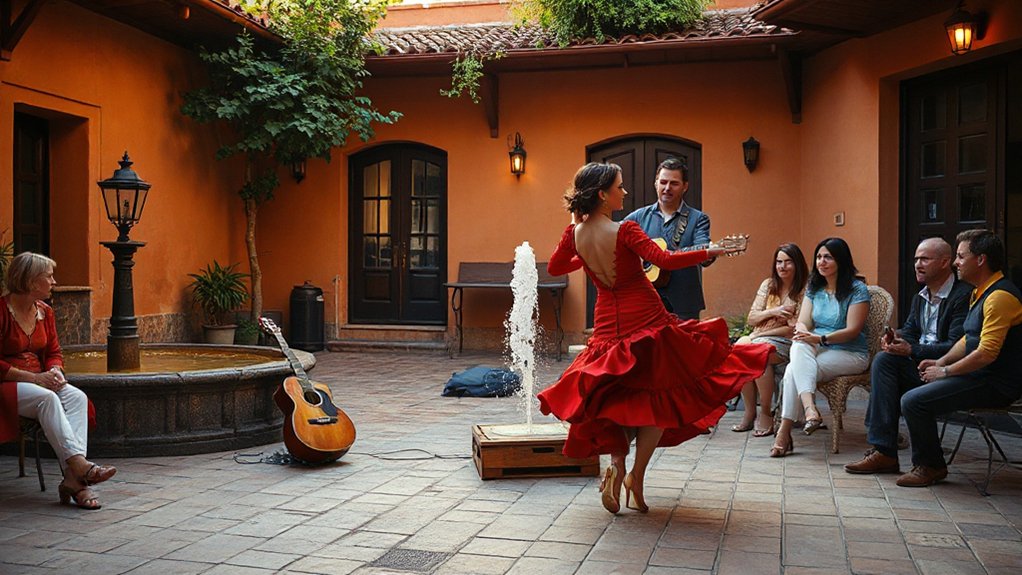
Flamenco today lives where communities gather, cross borders, and reinterpret tradition in real time. You observe how streets, plazas, and academies become living archives, preserving ritual while inviting nuance.
Place anchors practice: intimate taverns in Seville, hillside patios in Jerez, and migrant hubs along the Costa del Sol host sessions that blend memory with improvisation.
You notice that Community gatherings function as test beds for shared meaning, where power, gender, and history surface through cante, toque, and baile.
Cultural festivals crystallize this exchange, turning local pride into public ceremony and negotiation.
Yet the form remains porous: venues relocate, mentors adapt, and the audience shapes repertoires.
Tradition persists through dialogue, continuity, and daily, communal rehearsal.
Modern Flamenco: Fusion, Innovation, and Global Reach
Modern Flamenco pushes beyond tradition by embracing fusion and experimentation, weaving in rhythms, textures, and sensibilities from around the world while retaining core flamenco sensibilities. You observe how Cultural fusion expands timbres—from jazz and hip-hop to Middle Eastern and Latin percussion—without erasing the dance’s pulse.
This is Contemporary innovation in motion: artists reinterpret form, honor lineage, and respond to global audiences with new phrasing, staging, and production.
- Global collaborators shape practices without diluting identity
- Integrations of electronic, acoustic, and folkloric elements redefine technique
- Varied platforms expand reach, audiences, and cross-cultural dialogue
Experience Flamenco Authentically: What to Listen For and Where to Go
Listen for the pulse of the music—the clave-like swing and kick that drive the performance—from the serious footwork to the clarion guitar.
You’ll notice how the singer’s voice anchors the tempo and emotion, guiding you through the rhythm, call-and-response, and phrasing.
Seek authentic venues where you can hear improvisation, respect the performers, and start with a front-row or nearby seat to feel the intimate energy.
Listen For The Pulse
Experiencing flamenco authentically starts with tuning into the pulse—the driving heartbeat of the performance that guides tempo, mood, and tension. You’ll sense how rhythm shapes feeling, revealing the pieces’ rhythmic intricacies and emotional resonance in real time.
- Listen for the crown jewel moments where heelwork, handclaps, and guitar align, signaling shifts in mood.
- Notice subtle tempo changes that signal anticipation, release, or lament.
- Pay attention to the dancer’s foot-stomps and claps as they translate percussion into narrative.
In this container, you’ll decode how tempo drives narrative, not just sound. The pulse frames the emotional arc, enabling you to read the performance as a living conversation between singer, dancer, and guitarist.
Where To Experience Flamenco
Look for venues with live guitar, cante, and baile in balanced proximity; acoustics should support nuance rather than overwhelm it. In Andalusia, cultural festivals offer curated glimpses of tradition, blending regional repertoires with contemporary expressions.
Outside peak tourist zones, you may encounter impromptu performances in plazas that reveal community roots. Dress codes vary, but observing traditional attire among performers enhances the experience and signals lineage and pride.
Plan ahead, but leave space for discovery, and let the setting guide your listening priorities.
Frequently Asked Questions
How Does Flamenco Express Daily Life and Struggles?
You feel daily life and struggles through flamenco’s raw rhythm, guitars curving emotion as Guitar symbolism, and heels stamping resilience. You observe Costume significance shaping identity, while lyrics, clap patterns, and fervent cante del people reveal collective endurance.
What Makes a Cantaor or Cantaora’s Voice Distinctive?
Your cantaor or cantaora stands out through vocal techniques and tonal nuances, shaping emotional depth. You analyze their phrasing, accent, vibrato, and timing, recognizing how micro-deliberate nuance conveys sorrow, resilience, and storytelling within Flamenco’s expressive arc.
Which Palos Define Flamenco’s Emotional Range?
Metaphorically, the emotional range flows from siguiriyas to fandangos, with bulerías pulsing fastest. You analyze how palos shape mood, using rhythmic patterns and emotional storytelling to define sorrow, joy, tension, and resilience across flamenco’s expressive spectrum.
How Do Improvisation and Structure Interact in Baile?
You balance improvisation with structured cues, guiding rhythmic innovation while honoring choreographic spontaneity, you adapt footwork to the melody, and you anchor solos to established forms, analyzing interplay between freedom and form to shape coherent baile.
Where Can One Experience Authentic Flamenco Performances Safely?
Where can you experience authentic flamenco performances safely? Seek cultural safety and authentic venues, you’ll find them in respected tablones, established casas, and reputable tablaos; verify licenses, local recommendations, and audience respect before you arrive.
Conclusion
Flamenco isn’t just a show; it’s a heartbeat hammering through southern Spain, a storm of sound you can practically taste. You’ll feel cante’s ache, toque’s sharp weather, and baile’s seismic storytelling collide into one volcanic moment—and you’ll swear the walls are listening. It’s a living archive that refuses to stay still, morphing with every crowd, every guitar lick, every clap. If you listen closely, you’ll hear a history shouting, “Here, now, forever—keep feeling, keep dancing.”