
Intergenerational living in Spain blends enduring family obligations with contemporary housing realities, reshaping daily life, caregiving norms, and social mobility. You’ll see households where shared budgeting, routines, and mutual care balance work, schooling, and leisure, while elders, parents, and kids negotiate roles across generations. Regional variations and policy incentives modulate privacy and autonomy, yet collective care remains a cultural mainstay that buffers shocks and sustains social ties. If you keep exploring, you’ll uncover how this model continues to evolve.
Key Takeaways
- Intergenerational living blends tradition with modern housing markets, shaping family bonding, mutual caregiving, and social capital in Spain.
- Rising multigenerational households respond to economic pressures, housing shortages, and shifting expectations, reinforcing family-based support networks and stability.
- Shared finances and care roles, often gendered and informal, influence decision-making, task prioritization, and social dynamics across generations.
- Housing policy, urban design, and regional differences mediate privacy, autonomy, and the feasibility of multigenerational living.
- Technology, cultural norms, and regional histories enable coordinated care, routine management, and social cohesion within extended families.
What Intergenerational Living Looks Like in Spain Today
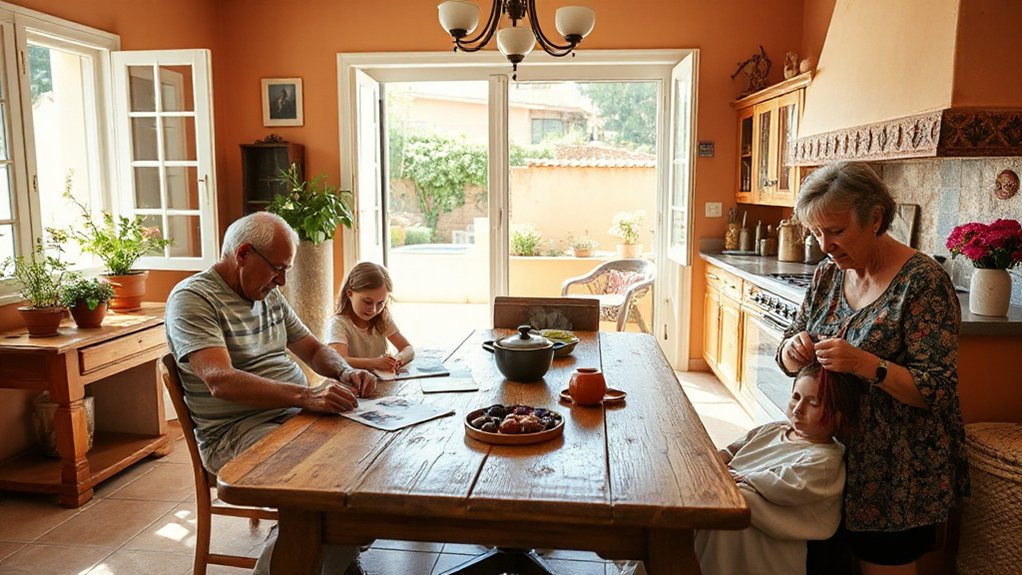
In contemporary Spain, intergenerational living blends traditional family expectations with evolving housing markets and social policies, shaping how households share space, time, and care. You observe households pooling rooms, kitchens, and routines, creating rhythms that fuse cultural traditions with pragmatic budgeting.
Daughter or son returns with siblings’ support networks, while grandparents contribute experience, caregiving, and emotional labor that stabilize daily life. You notice regional variation: denser cities emphasize flexible leases and cohabitation, whereas rural areas lean on extended kin networks and shared responsibilities.
Policy shifts—housing subsidies, care credits, and flexible work—murmur in the background, nudging practices without overturning custom. Ultimately, household resilience emerges from negotiated norms, mutual expectations, and adaptive routines that sustain families across generations.
Cultural traditions shape behavior, while resilience sustains it.
Why Multi‑Generational Households Are on the Rise
Multi-generational households are rising because economic pressures, housing markets, and shifting social expectations collide in ways that push families toward shared space and resources.
You observe a pattern where households pool income and skills, turning constraints into collaborative strategies rather than mere accommodation. In practice, intergenerational entrepreneurship emerges as parents mentor young adults while launching small ventures, blending experience with fresh markets.
You also see how family culinary traditions become social capital, sustaining ties across ages and communities. These dynamics aren’t random; they reflect a culturally nuanced recalibration of care, work, and belonging.
Yet you acknowledge variability: urban densification, regional livelihoods, and migrant histories shape how and why co-residence solidifies, producing distinct local rhythms within a national trend.
Demographic Trends Fueling Family Co-Residence
Demographic shifts are reshaping how families share space, with aging populations, immigration patterns, and changing household formation rules driving more people to co-reside. You observe a tightening of living arrangements as prospective elders seek support networks, while younger adults enter extended households to stabilize housing and care needs.
Cultural traditions subtly influence the timing and acceptance of multigenerational living, even as urban densities press toward shared spaces. Empirically, you note rising intergenerational co-residence in regions with slower fertility, higher migration, and stronger informal care networks, suggesting a mix of necessity and preference.
The picture links demographic pressure to economic resilience, where family co-residence buffers shocks and sustains labor market participation, without erasing regional variations or the pull of individual autonomy within tradition.
How Shared Budgets Stretch Household Finances
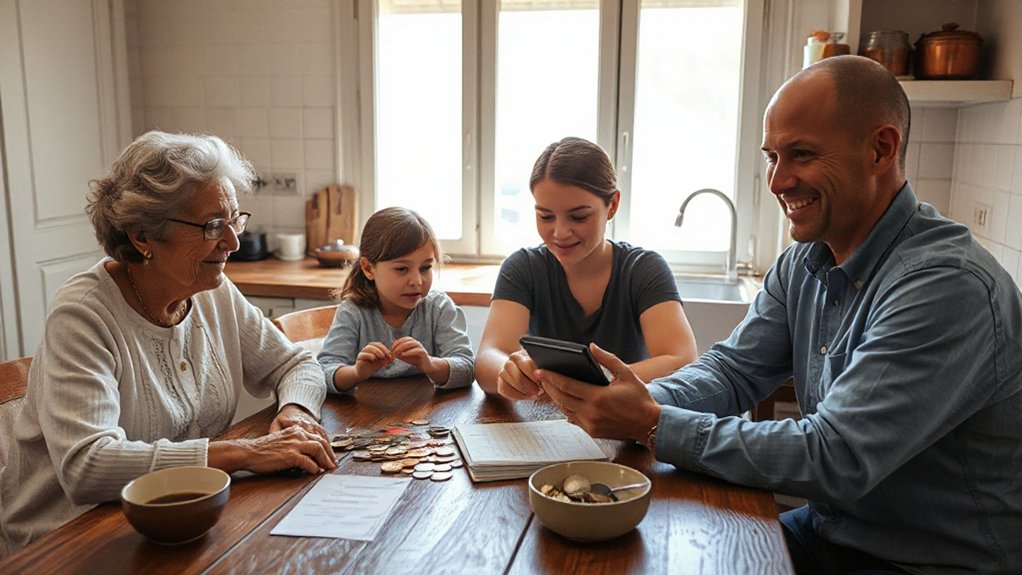
Shared budgets recalibrate how households weather volatility, turning plural incomes and shared expenses into a single, visible financial front. When you pool resources, you test how steady income streams interact with fixed costs, debts, and seasonal earnings.
You’ll notice shared finances can smooth shocks from illness, unemployment, or schooling gaps, yet also reveal tensions when expectations diverge about spending priorities. In practice, household budgeting becomes a collaborative instrument, aligning cultural norms with economic realities.
You may document how intergenerational households negotiate discretionary spending, savings targets, and debt repayment, using transparent rules to preserve trust. Empirically, these patterns correlate with resilience in Spain’s extended-family models, where collective provisioning stabilizes daily life and reinforces kin-based social contracts through mutual accountability.
Care Work at Home: Who Does It and How It’s Valued
Care work at home is a largely invisible labor market, yet it happens wherever care needs arise—from tending sick family members to supervising children and sustaining daily routines. It shapes how households value time, effort, and obligation.
You observe that who does this work varies by gender, generation, and class, even as its meaning accumulates in routines and moral talk. In Spanish households, elder companionship often blends with daily duties, translating affection into practical tasks that sustain intergenerational presence without formal acknowledgment.
You’re encouraged to see how caregivers negotiate scarcity, burnout, and reciprocity, balancing private obligations with social expectations. Recognition remains uneven: some labor is valorized as care, others as duty.
Caregiver recognition hinges on visibility, legitimacy, and the broader cultural economy of the home.
Elder Care in the Family: Expectations and Transitions
As families age, expectations around elder care crystallize at the junction of affection, obligation, and practicality, shaping who steps in, when, and how. You observe how Elderly independence often hinges on proactive planning, accessible services, and family traditions guiding daily routines.
This dynamic blends reverence for elders with the need for sustainable support, creating handovers that move between kinship duty and institutional options.
- Map roles early, balancing respect for elders with practical capacity.
- Weigh formal care versus in-home support against preserving family traditions.
- Document preferences to reduce ambiguity during shifts in responsibility.
Childcare Logistics When Generations Share a Home
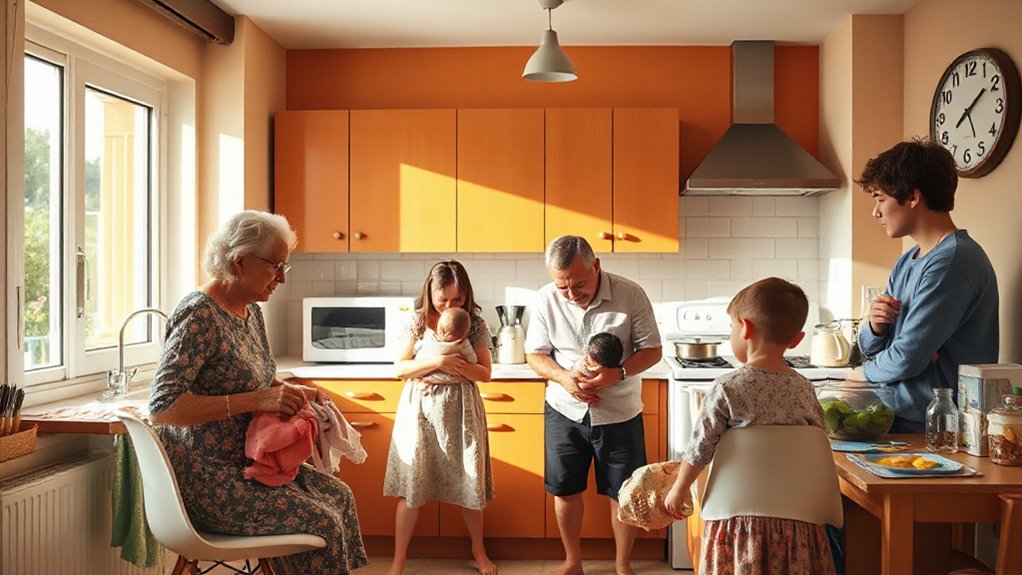
When families live under one roof, childcare logistics become a practical test of how shared values meet daily routines. You observe that routines formalize around school drop-offs, mealtime slots, and nap schedules, while kitchen conversations recalibrate expectations about attention and safety.
In homes where generations participate, you’ll see childcare logistics shaped by distributed expertise: elders offer continuity, parents leverage flexibility, and siblings contribute consistency. Yet tensions surface when routines collide with individual rhythms or cultural norms around closeness and privacy.
Empirical patterns point to codified, but flexible, calendars and clear communication channels, reducing ambiguities. You’ll find that shared responsibilities, when documented or ritualized, foster reliability, reduce stress, and reinforce community bonds, demonstrating how intergenerational living translates theory into everyday care practices.
Gender Roles and Decision Making in Extended Families
You’ll see how generational care dynamics shape who makes decisions and how those choices travel across households.
In extended families, decision roles aren’t fixed; they shift with age, care needs, and cultural expectations, creating patterns you can observe and test.
This framing invites you to compare contexts, question assumed hierarchies, and map how care, authority, and voice intersect across generations.
Generational Care Dynamics
In extended families, gender roles shaping caregiving and decision-making emerge from both longstanding norms and everyday negotiations, not from rigid scripts alone. You observe how care tasks migrate across generations, balancing reciprocity with practical constraints. You sense how elder voices anchor decisions without silencing younger perspectives.
Patterns reflect intergenerational traditions and the push to adapt care to changing circumstances, creating a dynamic mosaic rather than a fixed hierarchy. You note how cultural preservation coexists with pragmatic adaptations, shaping expectations about who provides support, when, and how.
You can identify evolving scripts that prioritize shared responsibility, while preserving dignity and relational harmony.
- Intergenerational traditions guide mutual caregiving expectations.
- Cultural preservation intersects with flexible, task-shifting arrangements.
- Decision-making blends collective input with filial reciprocity.
Decision Roles in Households
How do households distribute decision power when gendered expectations mix with lived negotiation in extended families? You observe that decision roles aren’t fixed but negotiated across generations and kin networks.
In many Spanish households, informal authority circulates: elders frame core priorities, while younger members leverage daily routines and care constraints to influence choices.
Gendered expectations persist, yet practical needs—school schedules, elder care, or finances—drive redistribution during household negotiations.
Intergenerational conflict surfaces when divergent values meet economic realities, yet collaborative problem-solving can realign responsibility without eroding respect.
You’ll find decision making often layered: immediate tasks handled by whoever has time, long-term plans shaped by collective input, and trust built through consistent communication.
The pattern reveals resilience in shifting, negotiated power within extended family life.
How Housing Policy Shapes Multigenerational Living
Housing policy shapes multigenerational living by coordinating access to affordable, suitable housing and the social supports that make extended households practical. You’ll see how policies filter through family choices, shaping whether cultural traditions flourish within shared spaces or strain under price pressures.
When housing affordability improves, you create room for elders, parents, and grown children to coexist with dignity, rather than fragment.
- Assess subsidies and rental caps that enable larger households without compromising quality
- Align housing standards with family needs, including adaptable units and accessible layouts
- Integrate social supports—care, transport, and financing—so families sustain multigenerational living
This approach foregrounds Cultural traditions and practical economics, linking policy to everyday household dynamics.
The Role of Urban Planning in Flexible, Larger Homes
Urban planning shapes how flexible, larger homes actually materialize on the ground, translating affordability and multigenerational needs into neighborhood form. You observe how architectural innovation meets practical constraints, testing layouts that expand living space without fragmenting communities.
In practice, zoning regulations often steer outcomes by permitting accessory dwelling units, adaptable core plans, and shared facilities, while limiting oversized parcels that would erode density. You map how these tools negotiate cultural expectations with market realities, noting that versatile designs can preserve street vitality and pedestrian access even as households grow.
The evidence suggests planners must align standards with performance-based criteria, ensuring safety, energy efficiency, and accessibility. This approach links social cohesion to measurable outcomes, offering a framework for scalable, inclusive housing strategies.
Spain’s Cultural Norms of Hospitality and Obligation
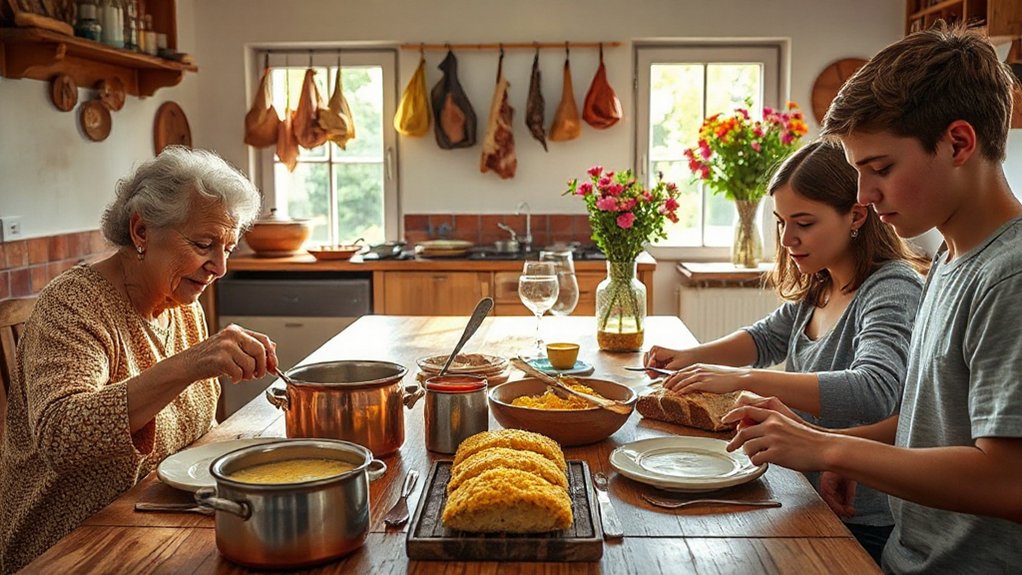
Spain’s cultural norms around hospitality and obligation shape how households negotiate hosting, reciprocity, and social presence in daily life. You observe how cultural rituals guide when guests are welcomed, meals are shared, and favors are offered, creating predictable patterns that bind families across generations.
You feel the tension between obligation and autonomy, as hosting becomes a form of social capital and emotional currency intertwined with kinship. The resulting atmosphere fosters Family bonding, while reinforcing boundaries that allow privacy and care to coexist.
You recognize that these norms sustain intergenerational cohabitation, shaping routines, empty-nest transitions, and neighborhood trust.
- Hosting as social capital and ritual reinforcement
- Reciprocity as a binding family mechanism
- Everyday presence shaping identity and belonging
School Life and Education in a Shared-Household Context
In shared-household classrooms, your daily routines blur formal study with family life, shaping what counts as a learning space beyond school walls. Multigenerational study rhythms challenge linear timelines, revealing how care duties, space design, and collective bargaining organize attention and access to resources.
Community learning supports emerge as informal scaffolds, offering culturally embedded practices that tighten or loosen the boundary between home pedagogy and school curriculum.
Shared Household Classrooms
Shared households reimagine classrooms as spaces where learning happens alongside daily chores and family routines, not apart from them. You observe how study time interweaves with meals, conversations, and care duties, shaping a practical pedagogy rooted in real life.
This approach blends cultural traditions with formal schooling, harnessing daily activities as instructional moments. You’ll find that knowledge circulates through shared spaces, with elders guiding younger learners and peers collaborating across generations.
The result is a learning environment that respects local contexts while testing universal questions about education, identity, and belonging.
- Generational collaboration turns everyday tasks into instructional moments
- Elders mentor while modeling cultural traditions and family rituals
- Peer learning integrates school concepts with home life and community values
Multigenerational Study Routines
In this setup, shared household chores become informal tutorials, with elders articulating cultural context and younger members applying it to problem sets, projects, and study schedules. You notice routines stabilize when feedback is brief, frequent, and concrete, linking academic goals to practical consequences.
This empirically grounded pattern varies by family structure, migration history, and gendered labor norms, yet consistently centers reciprocal mentoring. The result is a culturally nuanced ecology where schooling extends beyond the classroom and learning is everyone’s responsibility.
Community Learning Supports
What roles do community supports play in linking school life to daily routines inside shared households? You observe how campuses, libraries, and local mentors anchor learning to home rhythms, turning homework into shared practice rather than solitary labor.
In this framework, Intergenerational traditions shape study norms, while older residents translate curricula into lived examples, fostering Family resilience through responsive routines and mutual accountability.
You theorize that collective spaces scaffold homework time, meal planning, and transportation, reducing stress and widening access to tools, tutoring, and cultural capital.
Empirically grounded patterns show stronger discipline, higher literacy, and increased participation in community programs when households align school tasks with daily obligations.
- Shared study schedules
- Parent–child mentoring
- Local learning hubs
Work Patterns, Remote Work, and Scheduling at Home
In households near urban cores, paid labor remains structured yet flexible, enabling midweek overlap with elders’ caregiving and children’s schooling. Remote scheduling introduces staggered hours, nap-friendly blocks, and shared calendars that reflect trust and mutual accommodation.
Cultural norms influence which tasks are prioritized and how downtime is valued, shaping pressure points and relief valves alike. Theoretically, intergenerational households test traditional separation of work and family, while empirically, they reveal adaptive strategies that reduce strain and sustain care networks.
Community Ties and Volunteer Networks Within Families
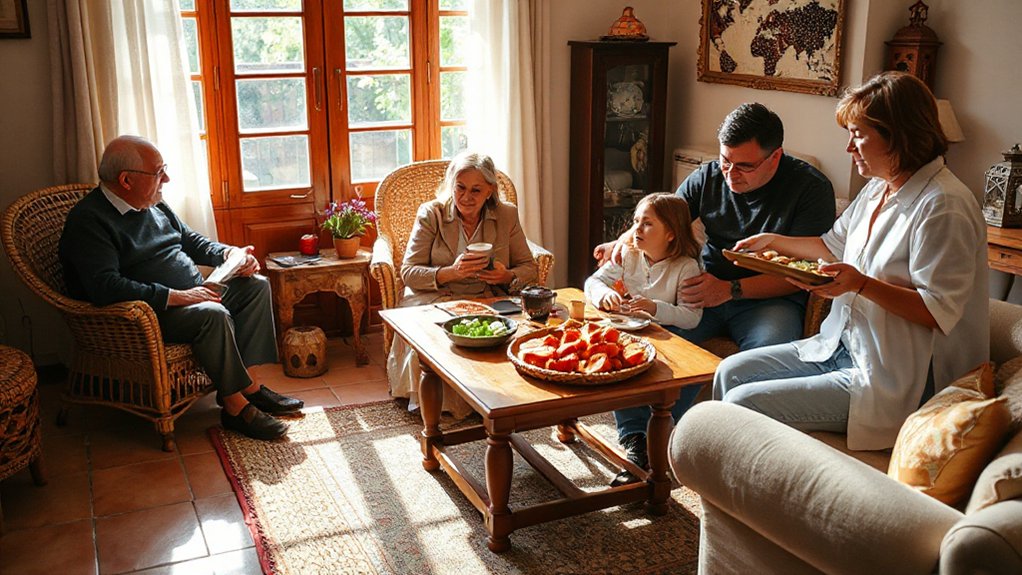
- Intergenerational friendships fuel reciprocal support
- Family mentorship organizes skill transfer across ages
- Volunteer networks synchronize domestic and communal needs
Health and Wellbeing: Informal Support at Home
Family members routinely step into informal care roles at home, shaping health and wellbeing through practical support, daily routines, and emotional presence that clinical settings often overlook.
You observe how elder companionship buffers isolation, providing predictable social contact that sustains mood and motivation during recovery or chronic management.
This informal care operates through everyday tasks—meal prep, medication reminders, transportation to appointments—while also embedding health monitoring as a habitual practice, not a formal intervention.
You note how intergenerational dynamics calibrate risk, with younger generations learning patient pacing and tolerance for communal caregiving.
Cultural norms in Spain emphasize familial duty, yet you also see strain when boundaries blur or care gets unevenly distributed.
The evidence suggests that trusted home support complements professional care, enhancing resilience and daily function without eroding autonomy.
Technology Bridging Generations Under One Roof
Technology can serve as a deliberate mediator of care when generations share a home, translating remote digital capabilities into tangible daily routines that reinforce mutual resilience. You observe how technology integration reshapes routines, enabling elders to participate in everyday decisions and younger members to contribute meaningfully without friction.
This dynamic rests on attentive design, where interfaces respect memory, language, and pace, fostering trust and smoother generational communication. By framing devices as cooperative tools rather than barriers, you illuminate cultural nuances that underpin Spanish households, showing how care unfolds through shared screens, schedules, and reminders.
- Shared calendars and reminders that honor each generation’s routines
- User interfaces adapted for varied tech literacy levels
- Routine-based communication channels that reinforce mutual responsibility
Social Mobility and Advantages of Intergenerational Living
Intergenerational living can propel social mobility by blending resources, norms, and networks across age groups, creating pathways that neither generation could access alone. You experience how shared households expand access to job leads, skill development, and informal mentorship, accelerating entry into networks traditionally gated by status.
The arrangement mediates risk, enabling experimentation with education or training without destabilizing footing, which can translate into higher earnings and career resilience. Cultural identity becomes a conduit for trust, as elders transmit tacit know-how and younger members bring tech fluency and new vocabularies to mainstream markets.
Food traditions anchor social capital, shaping reputations and community ties that facilitate opportunities. Observed patterns suggest intergenerational living buffers inequality while reinforcing transferable competencies across social strata.
Navigating Privacy and Autonomy in Shared Homes
How do shared homes balance the pull between collective welfare and individual privacy? In practice, you navigate a delicate negotiation where daily routines, boundaries, and shared spaces shape social trust.
You’ll find that privacy concerns arise not only from physical spaces but from expectations about time, noise, and decision making, while autonomy challenges test who holds agency over communal rules.
Empirically, families adapt through clarifying norms, rotating chores, and transparent check-ins, yielding a culture that honors both interdependence and personal space.
Theoretically, this balance reframes autonomy as contextual, negotiated, and evolving with life stages and migration.
Cultural nuance matters, as kinship models color perceived rights and duties.
- Clarify boundaries and consent for shared areas
- Schedule regular check-ins to renegotiate rules
- Align chores with individual needs and feedback
Regional Variations in Spain: Case Studies by Region
Regional differences across Spain reveal how regional histories, migration patterns, and local institutions shape family living arrangements in distinct ways. You examine Catalonia’s urban densification and intergenerational pooling as a response to housing costs, noting how cultural festivals reinforce proximity yet separate households through synchronized calendars.
In the Basque Country, you observe co-residential norms intertwined with strong community networks and traditional crafts that sustain elder care within familiar spaces. Andalusia shows extended kin networks adjacent to agricultural cycles, where seasonal labor shapes caregiving timelines.
Galicia highlights rural-urban drift, with diaspora ties influencing multigenerational cohabitation and mutual aid. Across regions, you theorize that family-first living adapts through culturally embedded routines, while traditional crafts and cultural festivals act as social anchors, shaping expectations and support mechanisms.
The Road Ahead: What May Change for Family-First Living
You’ll see that shifting generational policies and changing housing and care norms are likely to reshape how families prioritize time, money, and space together.
Empirical patterns suggest earlier generations push for affordable housing and formal care options, while younger cohorts favor flexible arrangements and community support networks.
As cultures diverge and converge, you’ll need to watch how policy experiments, market trends, and caregiving expectations co-evolve to support family-first living.
Generational Policy Shifts
Across generations, policy shifts aren’t random twists but evolving responses to changing family structures, economic realities, and cultural expectations. You’ll notice how reforms calibrate support for intergenerational living, steering resources toward practical collaboration, entrepreneurship, and shared risk.
- Intergenerational entrepreneurship incentives that encourage collective ventures over single-household ownership
- Cultural storytelling grants that valorize family-based care norms while widening public understanding
- Tax and subsidy reforms that recognize caregiving as productive labor within multigenerational settings
These shifts aren’t abstract. They’re empirically grounded, drawing on demographics, labor market data, and regional diversity to shape policy that sustains interconnected households.
You’ll see them test theories of kinship, resilience, and social cohesion, translating nuanced cultural expectations into concrete governance. The road ahead weighs efficiency against belonging in a Spain where generations collaborate.
Housing and Care Trends
What might housing and care look like as family-first living becomes more central to policy and daily life? You observe how housing layouts evolve around intergenerational needs, blending private space with communal ties.
Empirical patterns show multi-generational households citing Cultural traditions as both support and constraint, shaping design choices and neighborhood metrics.
Care regimes migrate from institutional models toward neighbors, relatives, and affordable services, yet Housing affordability remains a binding constraint that colors options for expansion, renovation, and shared guardianship.
Policy nudges encourage flexible zoning, subsidies for accessibility, and tax incentives, but cultural expectations mediate uptake.
You detect a shift toward modular, aging-friendly homes that preserve kin networks while reducing isolation.
In this road ahead, sustainability and social cohesion converge within everyday living practices.
Frequently Asked Questions
How Does Intergenerational Living Impact Mental Health in Spain?
Intergenerational living enhances your mental health by strengthening social ties and daily purpose. You experience intergenerational bonding that buffers stress, while observed mental health benefits emerge through routine support, community belonging, and culturally nuanced caregiving expectations.
Which Policies Best Support Multi-Generational Households?
You can support multi-generational households with housing affordability measures and robust social support. While skeptics worry about costs, you’ll see healthier family dynamics, reduced isolation, and empirically grounded benefits that culturally align with Spain’s intergenerational living.
What Are Common Conflicts in Shared Homes and Solutions?
You experience common conflicts in shared homes around household chores and privacy concerns, so you negotiate clear schedules, respectful boundaries, and flexible routines, testing empirically grounded norms while honoring cultural nuance and preserving harmony amid competing needs.
How Do Schools Adapt to Children From Larger Families?
Schools adapt by recognizing housing dynamics, tailoring class sizes, and deploying flexible schedules. You’ll see targeted educational adaptations, civic supports, and culturally nuanced practices, all theorized and empirically grounded, provoking suspense about how larger families shape learning environments.
What Role Do Culture and Tradition Play Inmodern Family Decisions?
Culture and tradition shape your family decisions as cultural norms and traditional values steer choices about housing, care, and work, guiding expectations, yet you question how evolving practices challenge those norms with empirical nuance and lived experience.
Conclusion
You observe that Spain’s living rooms become moving classrooms, where kinship rewrites economics, care, and identity. You sense intergenerational ties as ballast and buoy, stabilizing households amid shifts in income and aging. You note policy and culture tug in chorus, shaping norms of privacy and duty. In this pattern, you’re not just studying a trend—you’re tracing a society practicing coexistence, gaining resilience, and weaving future possibilities from the threads of shared roofs and shared lives.